

“Lightweight” gets thrown around a lot in the page builder world. We wanted to see what the numbers actually say, so we built the same page, twice, once with Spectra and once with Elementor, and ran both through three independent speed testing tools.
The Hypothesis
Our expectation going in: Spectra outputs static Gutenberg blocks, with minimal core CSS and no bundled JavaScript framework unless a specific component needs one. Elementor, by contrast, ships its own frontend rendering framework on every page, regardless of what elements are actually used on it.
If that’s true, the gap should show up in two places: how much the browser has to download and execute, and how much work the server does to generate the page in the first place. And it should widen as the page gets more complex. A simple blog post shouldn’t stress either builder much, but a product page full of components should expose the difference.
Also read: Beaver Builder vs Elementor vs Spectra: Which one is best for you?
Methodology
To keep this a fair, apples-to-apples test, we controlled everything except the one variable we were testing:
- Same starter template, installed once on each site, no content changes
- Same theme (Astra) on both installs
- Same plugin stack on both sites, with the single exception of the page builder itself (Spectra vs. Elementor)
- Same hosting environment, two identical staging installs, same WordPress and PHP versions
- No caching plugin and no image compression on either site. This was a raw, unoptimized test of builder output, not a test of what either site could achieve fully tuned
- No CDN on either install
We tested three page types that represent increasing layout complexity: a Homepage, a Complex Page (heavier layout, multiple components, structured sections), and a Blog Post (a simple content page). Each page was tested on Mobile and Desktop using Google PageSpeed Insights (5 runs per page/device). Pingdom and GTmetrix testing was run on Desktop, with GTmetrix tested once per page. All tests were run on August 13, 2026.
The Results
PageSpeed Insights (5-run average)
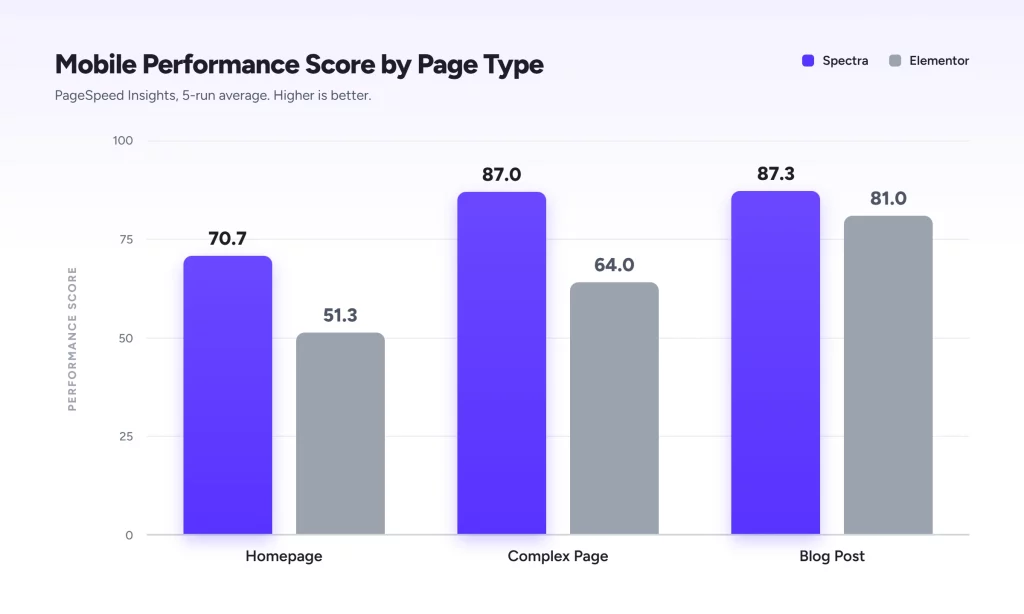
| Page | Device | Spectra Score | Elementor Score | Spectra LCP | Elementor LCP |
|---|---|---|---|---|---|
| Homepage | Mobile | 70.7 | 51.3 | 4.93s | 7.10s |
| Homepage | Desktop | 89.7 | 86.3 | 0.97s | 1.40s |
| Complex Page | Mobile | 87.0 | 64.0 | 2.90s | 6.50s |
| Complex Page | Desktop | 95.0 | 79.0 | 0.70s | 1.10s |
| Blog Post | Mobile | 87.3 | 81.0 | 2.90s | 3.20s |
| Blog Post | Desktop | 93.3 | 93.7 | 0.73s | 0.73s |
The Complex Page on mobile is the clearest result in the entire test: a 23-point score gap, and Elementor’s LCP running more than 2x slower. Notice the Blog Post on desktop, though, the two are essentially tied. The gap isn’t a blanket “Spectra is always faster” story; it’s specifically tied to how much is happening on the page.
GTmetrix (Desktop)
| Page | Spectra Score | Elementor Score | Spectra TTFB | Elementor TTFB | Spectra Fully Loaded | Elementor Fully Loaded |
|---|---|---|---|---|---|---|
| Homepage | 83% | 75% | 1300ms | 1500ms | 2.6s | 3.8s |
| Complex Page | 83% | 64% | 1300ms | 2500ms | 2.6s | 4.9s |
| Blog Post | 91% | 85% | 1100ms | 1300ms | 2.1s | 2.8s |
Same pattern: the gap nearly doubles on the Complex Page, where Elementor’s time-to-first-byte is almost 2x slower than Spectra’s.
Pingdom (Desktop)
| Page | Spectra Load Time | Elementor Load Time | Spectra Requests | Elementor Requests |
|---|---|---|---|---|
| Homepage | 1.81s | 3.39s | 71 | 75 |
| Complex Page | 1.39s | 2.49s | 39 | 61 |
| Blog Post | 1.15s | 1.86s | 39 | 63 |
Real-world load time nearly doubles under Elementor on the Homepage, and the request count gap is largest on the two content-heavier pages.
Why the Gap Exists
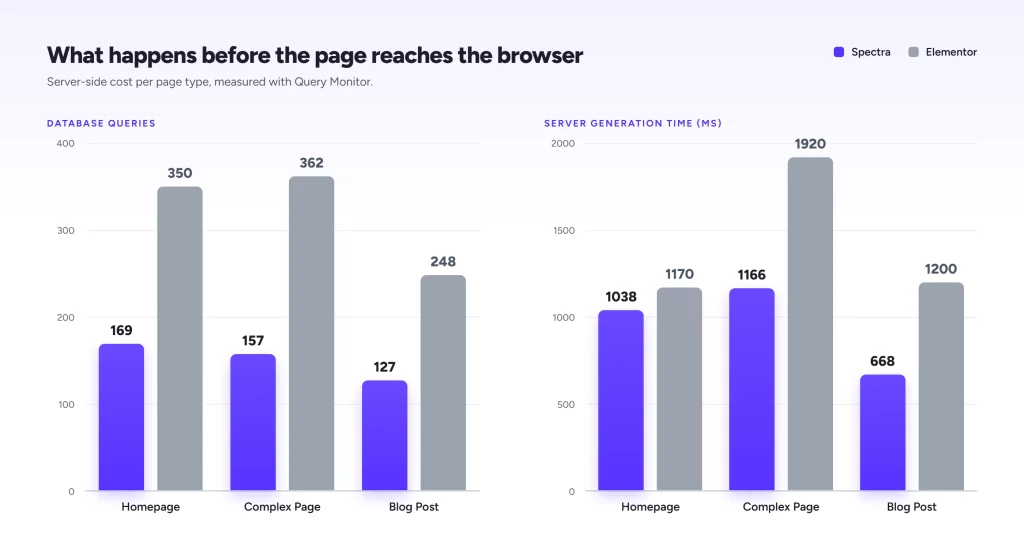
The browser-side numbers only tell half the story. The more revealing numbers came from Query Monitor, looking at what’s happening on the server before the page even reaches the browser:
| Page | Spectra DB Queries | Elementor DB Queries | Spectra Server Gen Time | Elementor Server Gen Time |
|---|---|---|---|---|
| Homepage | 169 | 350 | 1038ms | 1170ms |
| Complex Page | 157 | 362 | 1166ms | 1920ms |
| Blog Post | 127 | 248 | 668ms | 1200ms |
Database queries roughly doubled under Elementor on every single page we tested, and that held true even on the Blog Post, the page we expected to be the least demanding for either builder. Server generation time followed the same pattern, nearly doubling on the Blog Post specifically (668ms vs. 1200ms).
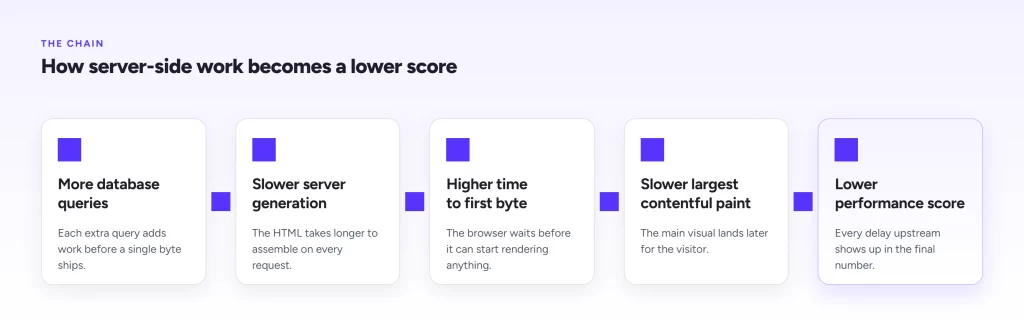
That’s the chain: more database queries → slower server-side generation → higher time-to-first-byte → slower Largest Contentful Paint → lower Lighthouse score. It’s not just a case of Elementor shipping a heavier frontend; a meaningful part of the gap is happening before the page even starts rendering.
Not everything points one direction, though. Elementor actually enqueued fewer CSS files than Spectra on every page we measured. The number of JavaScript files enqueued told the opposite story, favoring Spectra. So this isn’t “Elementor is bloated across the board.” It’s specifically JavaScript weight, database queries, and server-side generation time where the gap opens up, and it opens widest on the most complex layout.
We also want to flag one more honest wrinkle: Speed Index occasionally favored Elementor (Homepage Mobile, Blog Post Desktop), by a small margin. Our raw mobile runs on Elementor’s homepage ranged from 4.6s to 9.4s across just three passes, a wide enough spread that this looks like test-run noise rather than a real effect, but we’re calling it out rather than smoothing it over.
Limitations
A few things worth keeping in mind before drawing conclusions from this test:
- No caching plugin or image compression was active on either install. These numbers reflect raw, out-of-the-box builder performance, not what either site could achieve fully optimized. Caching in particular tends to shrink server-side gaps like the ones we found in database queries and generation time, so a cached comparison could look different.
- GTmetrix figures reflect a single run per page rather than an averaged set like PageSpeed Insights. Treat those numbers as a directional spot check rather than a statistical average.
- This is a synthetic lab test, run from a single location on a single day. It measures how the page performs under controlled conditions, not how it performs for real visitors across different networks, devices, and locations.
- Disclosure: this test was run and published on Spectra’s own blog. Both installs used the same starter template and an identical plugin stack, the only variable changed was the page builder.
Conclusion
The hypothesis held up, with a more precise shape than we expected going in. Spectra came out ahead on score, load time, and Core Web Vitals on nearly every page and device combination we tested, and the gap wasn’t uniform. It grew directly with page complexity, from essentially a tie on a simple blog post to a 23-point Lighthouse gap and more than double the load time on a complex layout.
The “why” turned out to be less about asset weight alone and more about what’s happening server-side: roughly double the database queries and up to 80% slower server generation time under Elementor, on every single page. That’s a more useful takeaway than “Spectra is lighter.” If you’re running content-heavy or component-heavy pages, that’s where builder choice will actually show up in your numbers.
Disclosure: This blog may contain affiliate links. If you make a purchase through one of these links, we may receive a small commission. Read disclosure. Rest assured that we only recommend products that we have personally used and believe will add value to our readers. Thanks for your support!

Recommended Articles
Divi vs Elementor: The 2025 Comparison You Need to See
Beaver Builder vs Elementor vs Spectra: Which one is best for you?